
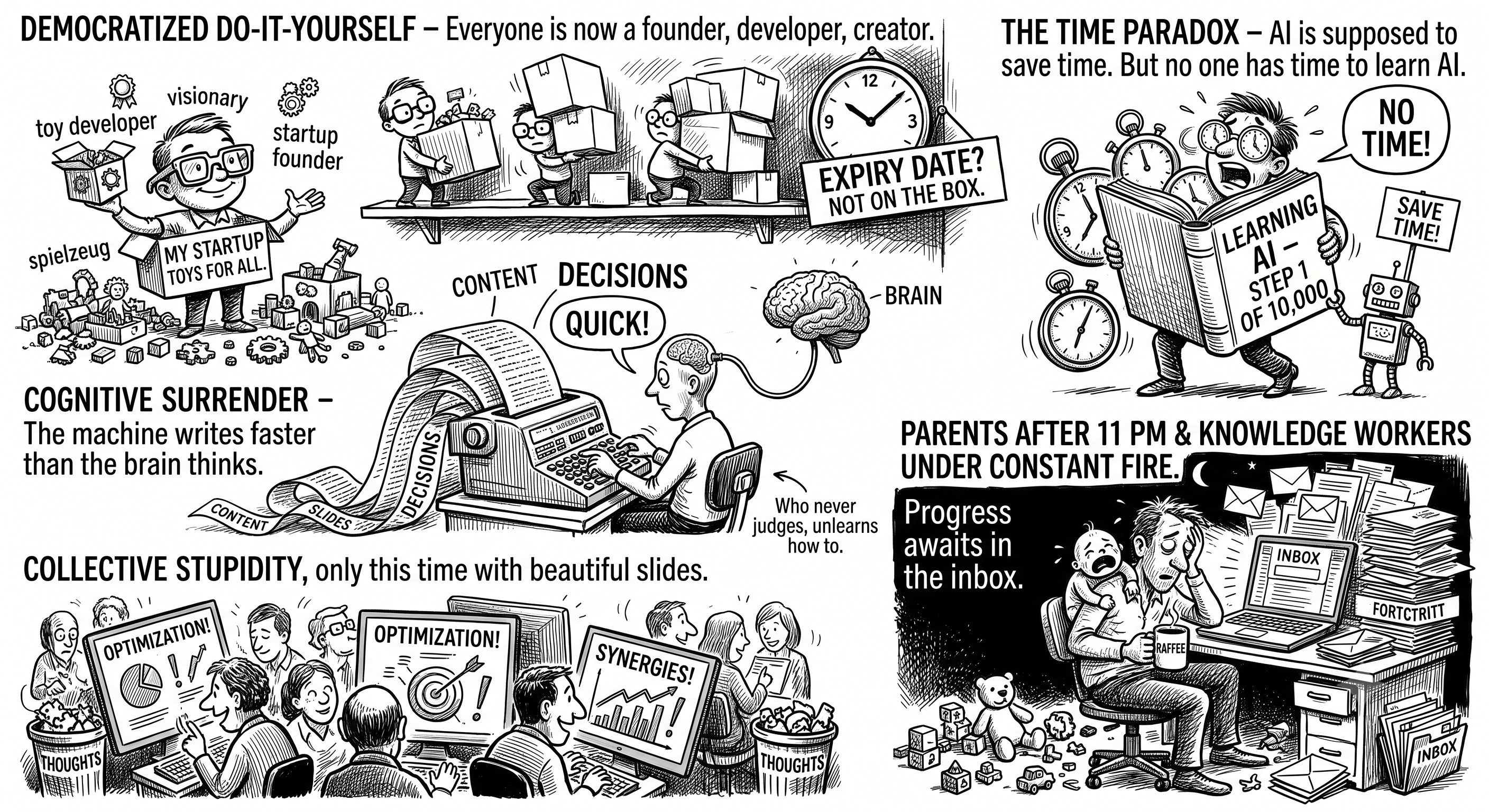
Cartoon: Nano Banana 2, Prompt: The Promptologist
Theresienstraße 6, Wednesday, July 22. Anthropic has tasked its Claude Communities worldwide with the same questions, and Munich chose this one: What does AI mean for my job?
A tough question. Or at least one that feels that way.
Zur deutschen Version des Artikels:

So the Promptologist shows up. Cheese platters, charcuterie, chilled Prosecco—the invitation didn’t overpromise. “Less conference, more dinner party,” they said. That’s true. The room is well-attended, the atmosphere is relaxed, and no one is pitching. No one is explaining why their startup is currently disrupting the disruption of disruption. That’s almost remarkable in Munich.
The format: no panel of experts, no stage, no presentation. Instead, group discussions at tables, two rounds, and at the end, someone from each table summarizes what was discussed in three sentences. The moderator emphasizes the three sentences. Seriously. Repeatedly.
What the evening brings: six tables, one topic, surprisingly similar answers
The Promptologist sits down, listens, and moves from table to table as the summaries are given. And he notices: The tables have independently arrived at very similar conclusions. Which, on the one hand, is remarkable. And on the other hand, it isn’t.
Thesis number one, unanimous: We’re all becoming builders. Anyone can now build things that used to require development teams and seed capital. From the first table to the last, this phrasing comes up — sometimes in English, sometimes in German —always with the same faint sense of unease behind it: This is actually unbelievable. And at the same time — what happens next?
One group puts it this way: This entrepreneurial dreamland has an expiration date. No one knows when. But everyone agrees that it has one.
Thesis number two, almost as unanimous: Job loss. Of course. It wouldn’t be a Munich evening on AI if the term job loss didn’t come up somewhere. It does. Repeatedly. But interestingly, that isn’t the real fear of the evening.
The real fear is more subtle. One group sums it up: We’re decoupling two things that belong together. The ability to produce artifacts—texts, code, presentations—is growing at a breakneck pace. The ability to evaluate these artifacts isn’t keeping pace. It’s a muscle. And muscles that aren’t used atrophy. One group calls this Cognitive Surrender. Another speaks of Scope Erosion. Yet another refers to Brain Shrink.
Three different terms for the same observation. Munich is productive this evening when it comes to inventing buzzwords for collective dumbing down.
Thesis number three, undisputed: Time. Not money. Not access. Not regulation—although that comes up briefly, somewhere between German regulatory frameworks and legislation, blah (the Promptologist likes to quote verbatim). The biggest obstacle to greater AI competence is that no one has the time to build it up. Parents after 11 p.m. Overworked knowledge workers. People with real lives outside the screen.
One group puts it quite laconically: Who actually has two weeks off to dive into AI?
No one. The answer is no one.
The quotes of the evening
Each group is to formulate its closing statement. The format is: Munich finds hope in hard questions by tackling [X] first. Mandatory framework, free content. The Promptologist collects the results:
…by tackling the gap between intelligence and governance first.
…by tackling time and trust first.
…by tackling access and participation for all population groups first.
…by leveraging what makes us unique and irreplaceable.
…by tackling our own mindset.
…by tackling which AI use cases are actually worth it first.
Six tables, six sentences. They all sound good. They all sound a bit like what you’d find on LinkedIn. The Promptologist isn’t saying this as a criticism—he’s saying it as an observation. It’s hard to come up with insights in two and a half hours over Prosecco and cheese that couldn’t also be a well-formulated Substack thesis. (Yes, even the Promptologist is posting this on Substack and loves you all.)
But maybe that’s not the point.
What Really Happened
Here’s what the evening actually accomplished, and the Promptologist means this without irony: A room full of people who normally ask themselves this question alone asked it together.
That sounds trite. It isn’t.
Because the question What does AI mean for my job? is one where it’s easy to fall into one of two camps: either the optimism of the LinkedIn coaches (You won’t be replaced by AI, but by people who use AI!) or the quiet panic of the wee hours of the night. There’s little in between.
On this evening, there’s more in between. The concerns are real—job loss, deskilling, data privacy, concentration of power in the hands of a few corporations, deepfakes, the creeping dependence on the next model update. And so are the hopes—a better work-life balance, the democratization of creation, accelerated research, solved problems we don’t even know about yet.
Both at the same time. In one room. Over charcuterie.
One person at the farthest table sums it up in a way the Promptologist finds most honest: We don’t have any best practices. We don’t yet know how to integrate AI effectively into our own work. We’re comparing it to social media right now—we know it’s not good for us, but we can’t stop. And we hope that this time, things will turn out differently.
Munich finds hope in hard questions by tackling our own mindset.
Yeah, maybe. Let’s start there.
The Promptologist leaves Theresienstraße 6 with a few bites in his stomach, ears still ringing a bit, and the feeling that Munich didn’t solve the AI question that evening. That wasn’t the mission, either. The mission was to ask it together. That worked out.
There’s a hackathon in two weeks. That’s when solutions are supposed to emerge. The Promptologist is curious to see if the event will also feature charcuterie.
The Promptologist, July 23, 26
Disclosure: This post was created with the help of Anthropic Claude.
Translation: DeepL