


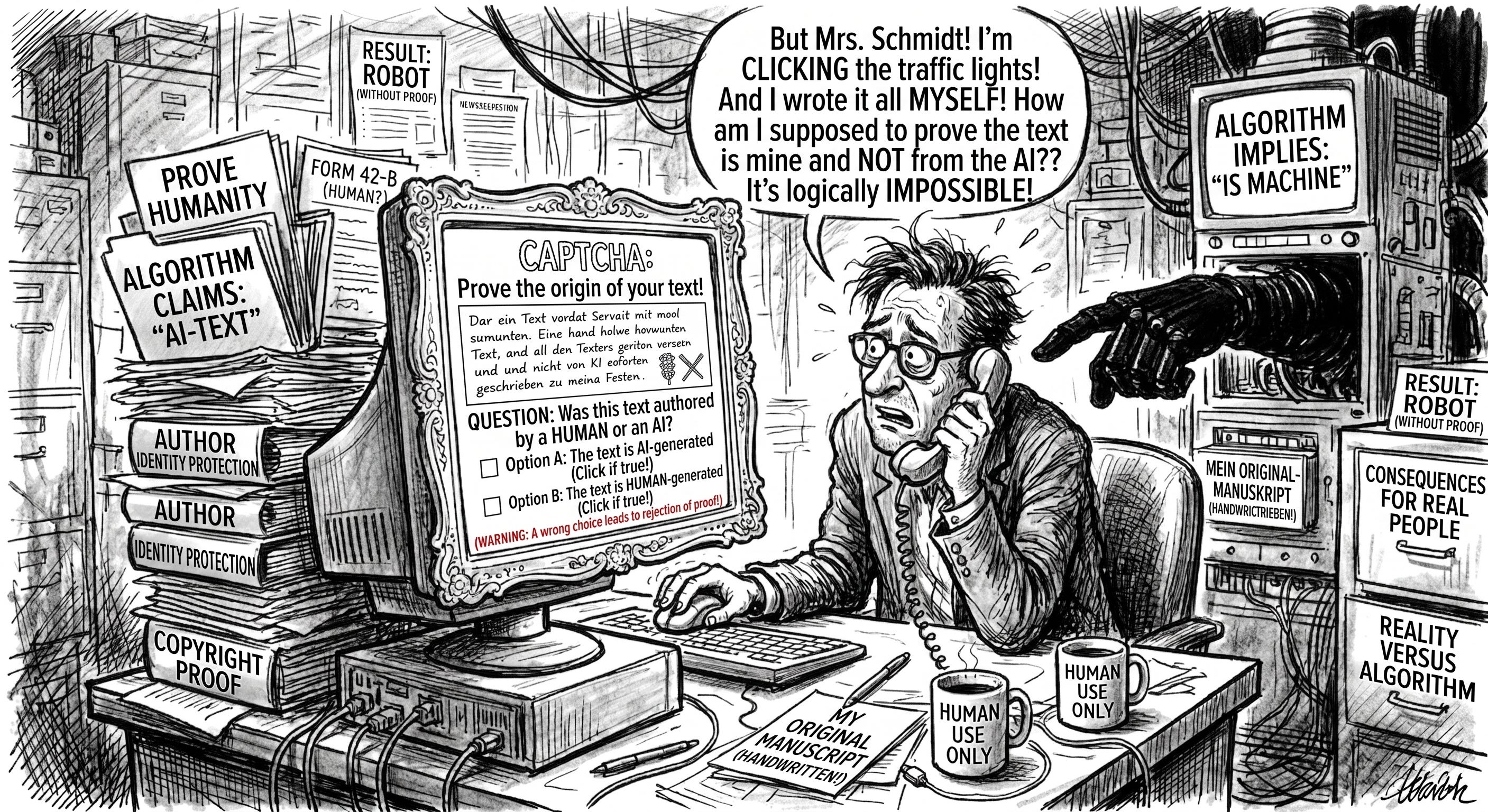
Nano Banana 2, Prompt: The Promptologist
A quick summary for those short on time:
AI detectors measure writing style, not origin. Independent studies find error rates ranging from 13 to 29 percent—while providers advertise “99.9% accuracy.”
Since August 2, the EU AI Act has required the labeling of AI-generated content—but it includes an exception: If a human is listed as the editorial responsible party, the AI content does not have to be disclosed.
Anyone falsely suspected of using AI cannot prove otherwise. Real-life cases—a college student, a high school student, and an author—show what this means.
Substack (with Pangram) and LinkedIn are responding to this same uncertainty with contrasting approaches: a percentage versus a report button.
My personal takeaway: What matters isn’t the AI content, but whether a human takes responsibility for the text.
On August 2, the EU AI Act, with its labeling requirements, went into effect. Just under two weeks earlier, Substackintegrated an AI detector into its own platform. And LinkedIn, which for years willingly placed writing assistants in its users’ timelines, is now phasing them out again. Three reactions to the same uncertainty, three completely different measures—a law, a percentage, a report button. And right in the middle of it all, a question that none of these three measures can answer: How do you prove that you’re human?
The german Version:

We’re actually familiar with this question in reverse, from every other online form: Prove that you’re not a robot—click the traffic lights. What used to be a tedious chore is now turning into a serious matter—with real consequences for real people who are suddenly expected to prove the opposite of what an algorithm assumes about them. But here’s the thing: there’s no such thing as a negative proof. That’s not a quirk of logic; it’s its fundamental principle. And that’s exactly what’s currently causing an entire, hyped-up market to crash.
What an AI detector actually measures
Let’s start with a sober assessment of the situation, because that’s what’s needed before we can get worked up about anything. An AI detector doesn’t read the source. It reads patterns: how predictable the word choice is, how consistently the sentences are structured, how smoothly the rhythm flows. These are characteristics that language models are highly likely to produce—but they’re also characteristics that a human with good editing skills and decent self-discipline can achieve all on their own. So the detector doesn’t answer the question “Was this written by a machine?” but rather “Does this sound the way machines tend to sound?” That’s a distinction that’s notoriously overlooked in public debate.
In July 2026, the research organization Epoch AI systematically measured just how significant this difference is in practice. They tested three of the most widely used tools—Pangram, GPTZero, and Originality.ai—on over a thousand text samples, half of which were generated by humans and half by machines. The results are revealing in both directions. When a language model is given a simple prompt such as “Write a short story about a lost dog,” all three tools detect the machine-generated text with near-perfect accuracy. However, when the same model is given five text samples from a real author and instructed to mimic her style, the detection rate drops to 82 to 90 percent—a gap of 10 to 18 percent. With academic texts, the results become even less clear-cut: Here, the detectors fail to identify between 24 and 29 percent of AI-generated texts, and in some combinations, nearly one in two. The reason is as simple as it is inconvenient: Academic prose is already standardized, passive, and full of clichés—meaning it lacks precisely the statistical irregularities that detectors normally latch onto.
And the flip side? According to the same study, false positives—where real people are mistakenly flagged as machine-generated—are practically nonexistent on Pangram and GPTZero; on Originality.ai, however, they occur in 3.8 percent of all human-written texts, and in fiction, as often as one in ten. A practical test published by the trade magazine Digital Publishing Technologies in May 2026 under the title “The Text DNA” yields a similar figure: about 15 percent false positives among common detectors—one in every six to seven people is wrongly accused. The article also cites a case from its own field: In June 2026, the FAZ took a guest column offline after an AI detector flagged it—with the editorial team adding, with remarkable honesty, that the tool used was “by no means perfect” and provided “no definitive proof.” Exactly. And yet, the text was taken down anyway.
Incidentally, anyone who wants to be fooled can do so effortlessly. If a language model is specifically tuned to a particular human writing style, the detectors’ hit rate in the aforementioned practical test drops from 97 to 3 percent. To put it bluntly, the tools primarily catch the unsuspecting—not those who truly intend to deceive. Meanwhile, research teams are working on deeper-level features that analyze not the style, but the narrative and thought structure of a text—and are designed to detect AI in over 90 percent of cases, even after the text has been polished. However, this is still in the research phase—not a product you can subscribe to today for 19 euros a month.
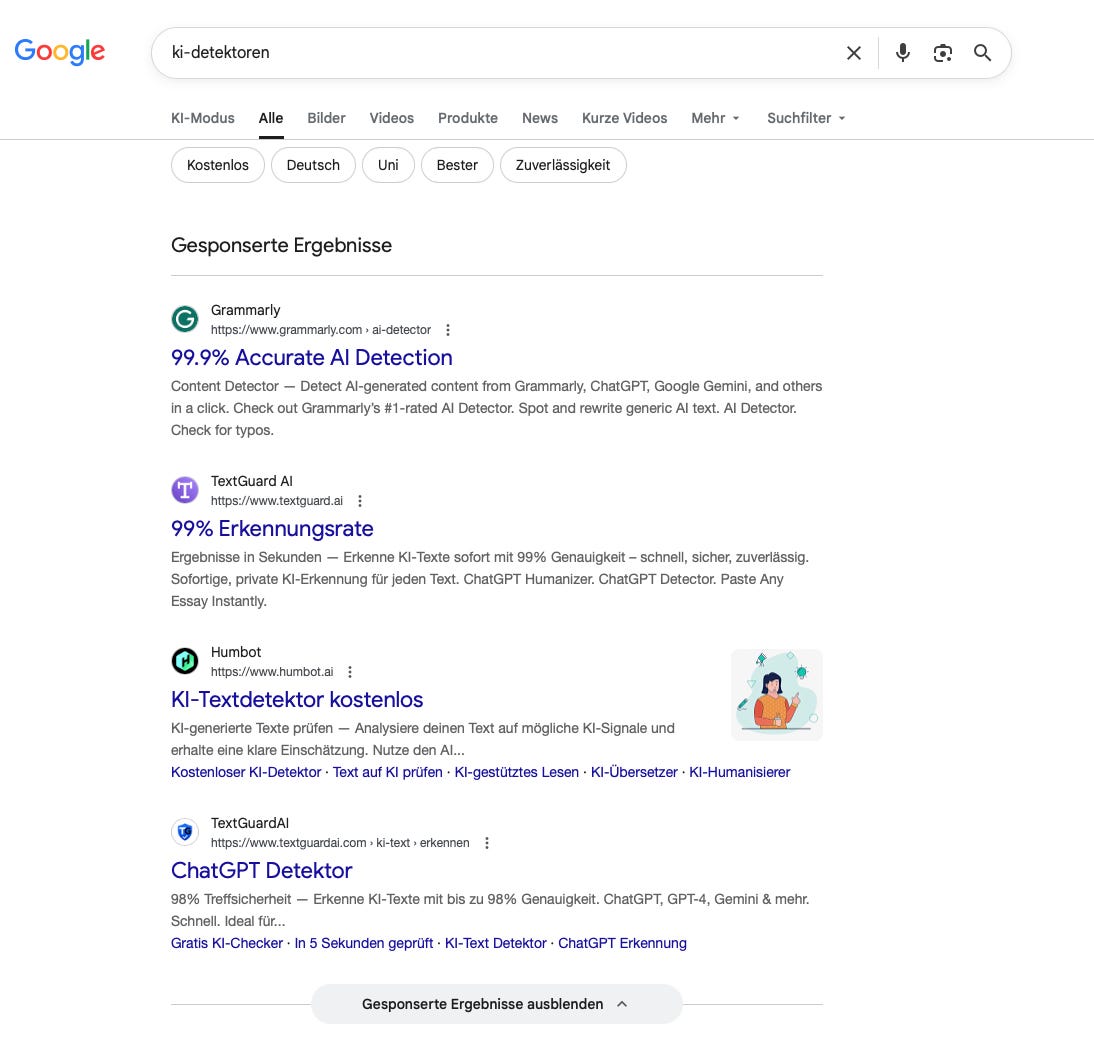
99.9% detection rate: A blatant lie or just marketing?
Screenshot Der Promptologe
A quick look at your own Google search shows what you can actually subscribe to. The top results for “AI detectors” are, without exception, paid ads: Grammarly advertises “99.9% Accurate AI Detection,” a provider called TextGuard AI boasts a “99% detection rate,” and another claims “98% accuracy.” Judged by what Epoch AI has independently measured, these are no longer exaggerations, but figures that border on being misleading. It is this kind of number-crunching that defines the industry’s hypersonic capitalism: growth first, truth later—if at all.
In principle, the same fundamental problem applies to images, audio, and video—just with different providers. Hive AIand Reality Defender officially achieve an accuracy rate of around 98 percent for image and video deepfakes, with the latter using a shared interface for images, video, audio, and text. When it comes to audio, providers like Pindrop stand out, specializing in voice clones—though their numbers are significantly less reliable when it comes to short, compressed clips, such as those found in podcasts or on the phone. And with video, the biggest weakness is simple: compression. A video that’s been passed around on Instagram or TikTok is harder to verify than the original—detection software and platform logic work against each other.
What the Law Actually Requires
Article 50 of the EU AI Act has been in effect since August 2. To understand it properly, it’s worth looking at the original text rather than yet another summary—I did myself the favor of doing so. The short version: The law doesn’t solve the detection problem; it shifts it. Instead of the (technically unsolvable) question “Can it be detected?”, the EU poses the administrative question “Who must label it, when, and how?”
Specifically, Paragraph 2 requires providers of AI systems that generate synthetic audio, image, video, or text content to label their output in a machine-readable format—“to the extent technically feasible.” Systems that merely serve as an “auxiliary function for standard editing” or that do not significantly alter user input are expressly exempt. This wording covers almost exactly what LinkedIn has just scaled back its writing assistant to: pure spell-checking instead of rephrasing.
Things get more interesting in Paragraph 4, the actual core of the public debate. Deepfakes in images, audio, or video must be disclosed, although for obviously artistic, satirical, or fictional works, a discreet note that does not interfere with enjoyment is sufficient. The same generally applies to texts on topics of public interest—with one exception that I consider the truly decisive point of the entire paragraph: The labeling requirement does not apply if the content has been subject to human review or editorial oversight and a natural or legal person bears editorial responsibility for the publication.
Feel free to read that twice. The European legislature—which may be accused of being technologically out of touch but rarely of lacking a sense of what matters most—has explicitly decided here against using the AI content as a criterion and in favor of human responsibility. The decisive question is not how much of the text was generated by a machine, but who is accountable for it. This is remarkably uncontroversial for a law that is publicly discussed primarily in terms of labeling requirements—and it is, as I’ll reveal here, a position that I will explicitly endorse at the end of this text.
What the law does not do: It does not replace retrospective detection. Watermarks can be removed, labeling requirements are not followed by everyone, and those who do not comply rely on the fact that no one will check. Detectors like Pangram step into precisely this gap—they promise to achieve retrospectively what the legislature would have preferred to regulate at the source.
The Proof That Cannot Exist
And that brings us to the real problem. Anyone accused of having generated a text with AI cannot prove the contrary. There is no method by which a person can retroactively demonstrate beyond a doubt that no machine was involved. At most, one can document their own work process—version histories, drafts, research notes—and even that can be dismissed as insufficient or, in a worst-case scenario, forged. You can’t prove a negative. This is not a new insight, but it is currently claiming new, very real victims.
In February 2026, Orion Newby became the first student to win a federal lawsuit against allegations that he had cheated using AI. A New York State court ruled that the findings of his university, Adelphi University, were “without valid basis and devoid of reason.” His family paid six-figure legal fees for this. Shortly thereafter, a family in Palo Alto filed a lawsuit after their son was disciplined in high school on suspicion of using AI. At least five such federal lawsuits have now been documented, and more than 25 universities, including MIT, Yale, and UC Berkeley, have since restricted or completely banned the use of AI detectors in academic settings.
The problem doesn’t end at the university gates. British author Mia Ballard had turned her thriller “Shy Girl” into a self-published success until the publisher Hachette added it to its regular catalog. Following suspicions voiced online, three different AI detectors concluded that the book was most likely written with machine assistance. Hachette withdrew the title; the New York Times reported that Ballard continues to deny the allegation to this day. Whether she’s right is something no one will ever be able to prove—neither she nor the publisher. That’s exactly the point.
These cases aren’t footnotes; they’re the systemic flaw that arises when a probabilistic statement is treated as evidence. A detector provides a number. An institution turns that into a judgment. And the person affected suddenly finds themselves in the position of having to refute something that, by definition, cannot be refuted.
Substack, Pangram, and an Anonymous Voice I Agree With
Amid this controversy, Substack introduced the “Scan for AI Text” feature on July 21, developed in collaboration with the provider Pangram. Since then, any post on the platform with 100 or more words can be scanned; the result indicates the estimated percentage of the text that is likely AI-generated. Substack CEO Chris Best announced this in a post titled “Against Claudefishing”—a play on “catfishing” that aptly describes the breach of trust it refers to: Readers invest their attention in something that isn’t the product of human thought, without realizing it. A sore spot, no doubt.
However, the solution Substack offers is precisely the one described in the previous section—with all its limitations. It claims an accuracy of 99.8 to 100 percent, with a false-positive rate of about one in ten thousand. These figures sound significantly more optimistic than what Epoch AI has independently measured for comparable tools—though they aren’t directly comparable, given the different versions and test bases. Added to this is a structural annoyance that surfaces in the comments under the best critique of this feature that I’m aware of: To disable the scanner for your own site, you first have to run your own text through it—and in doing so, whether you want to or not, you’re constantly providing Pangram with fresh training material.
This criticism comes from the anonymous author Micky, who, in a post titled “The Business of AI Scores,” said everything there is to say on this topic—and did so better than I could summarize here. Her key observation: A detector “passes judgment on style, not on origin”—it doesn’t answer “Did a machine write this?” but rather “Does this look like the way machines tend to write?” And because language models have been trained on good, polished prose, carefully edited text—of all things—becomes more suspicious than raw text. Micky puts it this way: “Writing in a conventionally good style has thus become more suspicious than writing in an idiosyncratic style.” Paradoxically, someone who has developed a polished style over the years risks a worse result than someone who simply writes whatever comes to mind.
And she hits on another point that is rarely articulated so clearly: Providers like Pangram sell “not truth, but the satisfaction of a need for control, the alleviation of an uncertainty that wouldn’t be nearly as loud without them.” That’s a sharp observation, and it strikingly aligns with what the independent studies from the previous section summarize in dry percentages. Micky has decided to disable the AI score under her own article “to leave you to your own judgments.” It’s a gesture I can understand.
LinkedIn: First the Dealer, Now the Rehab Counselor
While Substack is unsettling its audience with a new figure, LinkedIn is doing the exact opposite. For years, the platform actively promoted generative writing aids and pushed them into users’ timelines—with the result that 41 percent of long posts over 250 words and 30 percent of short posts are now entirely machine-generated, the highest level of AI saturation among the major platforms. The response came this summer: its own AI writing assistant was scrapped and replaced with a pure spell-checker that no longer rephrases anything. Added to this was a new report button with the apt name “Appears to be AI-Slop,” which has been gradually rolled out since early August.
On August 7, the Wall Street Journal reported on another feature that is still to come: In the future, users will be notified when others perceive their posts as “bot-like”—a social feedback mechanism that goes beyond mere reporting and aims to steer behavior directly through social feedback. One could view this as a logical progression or as a slightly grotesque twist: the same platform that first systematically accustomed its users to AI writing tools is now teaching them how not to sound like an AI. It’s like a drug dealer suddenly offering addiction counseling—though, interestingly, LinkedIn continues to operate its own AI features while combating third-party AI content. This dual role as both provider and regulator deserves a separate aside, regardless of the technical detection issue.
A Sober Assessment
What remains when you combine the market overview, the legal text, and the specific outcomes? An AI detector is a style analysis tool with an error rate that falls somewhere between “noticeable” and “significant,” depending on the text you feed it and which provider you ask. It can serve as a clue, not a verdict. The EU AI Act requires labeling at the source, not retroactive clarification—and it even acknowledges that human editorial responsibility is more important than the sheer proportion of AI involved. And wherever institutions ignore this nuance and turn a probability into a verdict, real harm is inflicted on people who cannot defend themselves against an accusation that, by definition, cannot be refuted.
My stance on this
The following paragraph explicitly reflects my personal opinion—not a proposed solution, nor a recommendation for action for editorial teams or platforms, but rather a stance I have developed for myself when dealing with texts. This applies expressly only to text, not to images, audio, or video—those are different areas with different risks, such as with deepfakes, where provenance certainly plays a role.
It simply still comes down to the text. Quite simply: Is the text relevant to me, do I learn something valuable, do I enjoy reading it, can I learn something? Then it’s irrelevant whether the text was written purely by a human or whether an AI helped with the research, provided a critical second reading, or even wrote the entire text.
The other decisive criterion: A human is responsible for the text. That person decided to publish this text because it meets their standards. Then, as I said, it’s of little relevance whether and how AI was involved. Out of courtesy, however, I expect that everyone involved in a text be named—including an AI.
Remarkably, this personal stance aligns with a provision in EU legislation that hardly anyone cites in public debate: The legislator also exempts editorially responsible texts from the labeling requirement as soon as a human takes responsibility for them. That doesn’t make my opinion an objective truth—it remains an opinion. But it’s a nice coincidence that, of all things, an EU legal text and my Substack column arrive at the same conclusion.
And now, for anyone who’s still wondering—here’s the disclosure:
This post was created with the help of Anthropic Claude.
Translation: DeepL
The Promptologist August 10, 2026

My insights from the wonderful world of AI development
Sources
Market Overview / Research
The blind spot in AI detection (Epoch AI study, Jaeho Lee) – digital-publishing-report.com, July 28, 2026
Text DNA – digital-publishing-technologien.de, May 12, 2026
Top 5 Deepfake Detection Tools of 2026 – Deepak Gupta
Deepfake Detection Companies: 12 Top Vendors (2026) – DeepfakeDetector.ai
Legal Framework
Article 50: Transparency Obligations for Providers and Operators of Certain AI Systems – artificialintelligenceact.eu (Future of Life Institute), Original Text
Ethics / Case Studies
A Palo Alto high school student was accused of AI cheating – SF Standard, May 11, 2026
AI Cheating Lawsuits Tracker (2026) – GradPilot
I Write Books—AI Helps Me Do It—So What? (The “Shy Girl” Case / Mia Ballard / Hachette) – digital-publishing-technologien.de, April 21, 2026
Substack / Pangram
Chris Best: Against Claudefishing
Micky: The Business of AI Scores – The Serpent Under’t, July 28, 2026
Substack adds AI detection to fight ‘Claudefishing’ – The Next Web
LinkedIn Wants Users to Rely Less on AI. Maybe a Lot Less. – Wall Street Journal, August 7, 2026
LinkedIn Does a 180 and Is Now Against AI – all-ai.de
LinkedIn Is Trying to Reduce AI-Generated Content – Dataconomy DE
LinkedIn Takes the Lead – Report Poor AI Content with the Click of a Button – Gamestar