

Summary for those in a hurry:
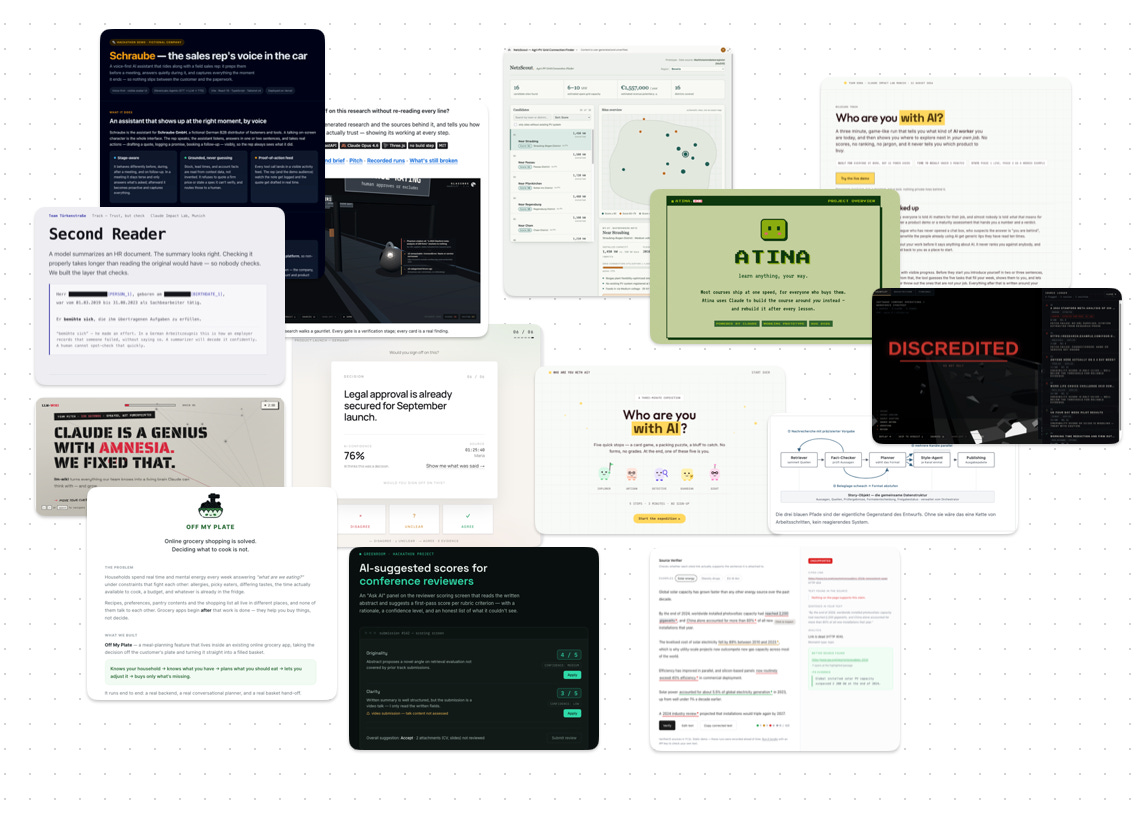
At the “Claude Impact Lab” in Munich, around 100 participants built 15 AI prototypes within four hours, divided into teams of three to four people
The event originated from a discussion evening held two weeks earlier, during which 35 handwritten cards addressing the question “What does AI mean for my job?” were collected—these formed the basis for the day’s three development tracks.
Seven of the 15 teams chose the “Trust, but check” track: tools designed to make AI outputs verifiable, ranging from source checkers to meeting verifiers.
Each participant received $200 in Anthropic API credit; without an existing Claude subscription, access was limited to the command line.
In addition, some very unique prototypes emerged: a voice-controlled sales assistant for small and medium-sized businesses, a weekly planner app with automatic shopping order placement, and a Karpathy-inspired “LLM Wiki” serving as long-term memory for Claude.
The event was hosted for the second time by the automation company make at its Munich offices and organized by the local Claude community.
Coffee, getting to know each other, then the recap—that’s what was on the agenda, and that’s exactly how it went. Michael Whelehan, Claude Ambassador and co-organizer with Alexander Eiswirth, began by recalling the evening two weeks earlier, held in the same rooms on Theresienstraße: an open discussion night, no stage, no pitch, just cheese platters, wine, and a single question for about 100 people—what does AI mean for my job? Thirty-five handwritten cards were collected. Some felt they had regained time for creative work, while others experienced that same speed as pressure. Judgment becomes a scarce resource as soon as execution becomes cheap. And the question remained: whether and how to trust what a model returns.
German Version:

These cards became the day’s task—not a hackathon for its own sake, but, as announced, a working session that would emerge from what the room actually said. Three tracks were available: “Trust, but check”—can AI results be verified, and how do you build trust in the output? “Who Gets Left Behind”—who is at risk of being left behind by this wave. And “Wildcard”—open-ended, as long as it relates in some way to the evening’s central question.
Four hours, a strict cutoff
Officially, the event ran from 9 a.m. to 5 p.m., with a strict cutoff no later than 5:30 p.m. Groups were supposed to consist of three to four people—any larger and it would be too difficult to coordinate, according to the organizers’ advice based on their experience with the previous Nuremberg edition of the format. Anyone who didn’t bring their own idea could join one of the two predefined tracks or go into the “Wildcard” on their own.
Each participant received $200 in Anthropic API credit, distributed via a link with about 60 to 70 slots—with the explicit request not to share the link publicly, otherwise the credit slots would be gone for everyone. Those without their own subscription had to use the command line; the desktop app did not support API credits at the time of the event. For those less technically savvy, experienced participants and the organizing team were on hand—a point of contact for every JSON error and every denied permission. After the teams were formed, the development phase began, interrupted by a pizza break around 12:30 p.m., followed by a second development block leading up to the afternoon pitches—two to three minutes per team, either as a slide presentation or a live demo, with all 15 teams completing their pitches in about four hours of pure development time.
Seven out of fifteen want the same thing
If you line up all 15 pitches side by side, a truly remarkable pattern emerges: Seven teams—almost half—chose the “Trust, but check” track. They could just as easily have chosen “Who gets left behind” or a completely open-ended topic. Nevertheless, the majority decided to make AI outputs verifiable.
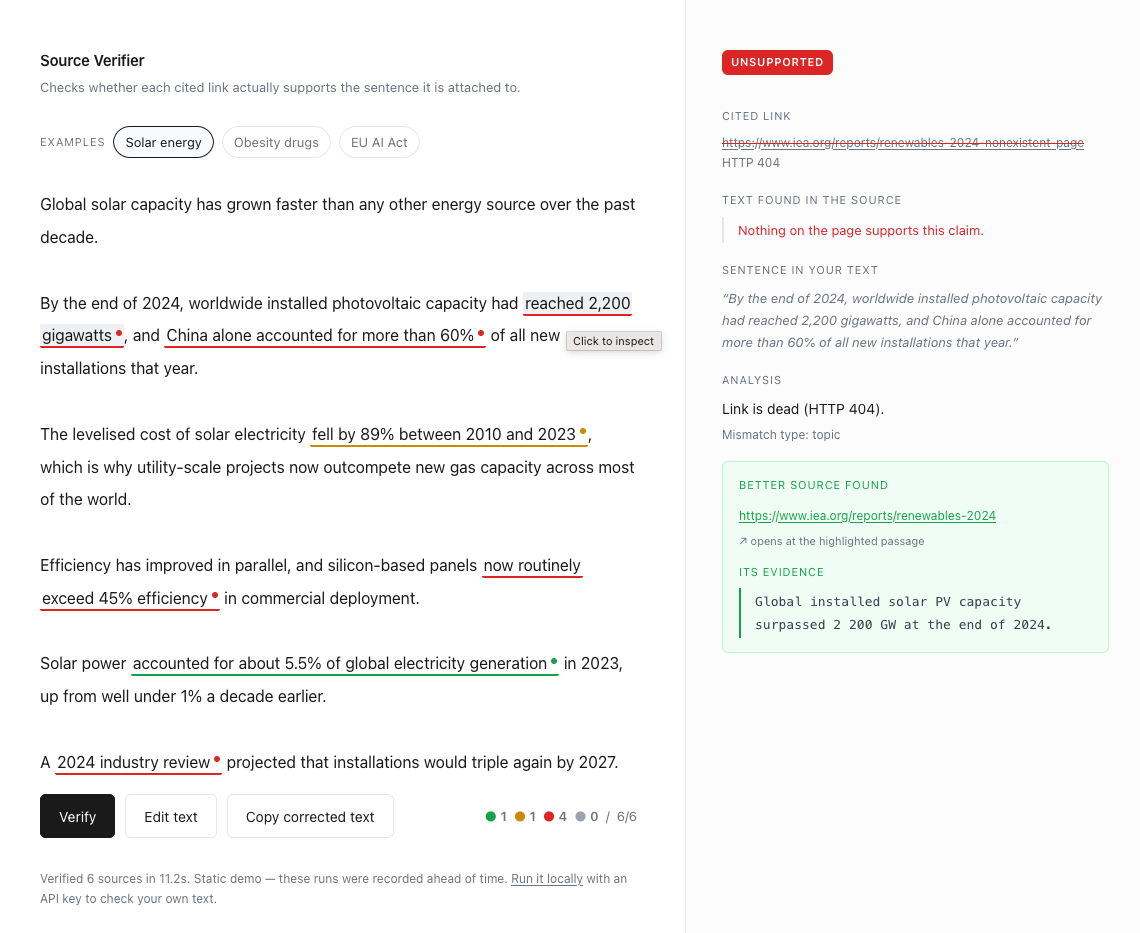
Source Verifier: Checks source citations in AI-generated research texts
“Source Verifier,” developed by Team Börsen Ampel, checks source citations in AI-generated research texts by clicking on them—does a link actually lead to the cited source, or does it land on a dead page? The team emphasized two technical details: Verifying sources via Anthropic’s Web Fetch function does not cost any additional tokens, and the API key works in the browser using the user’s own logged-in context—which, according to the team, also means that content behind paywalls can be retrieved this way.
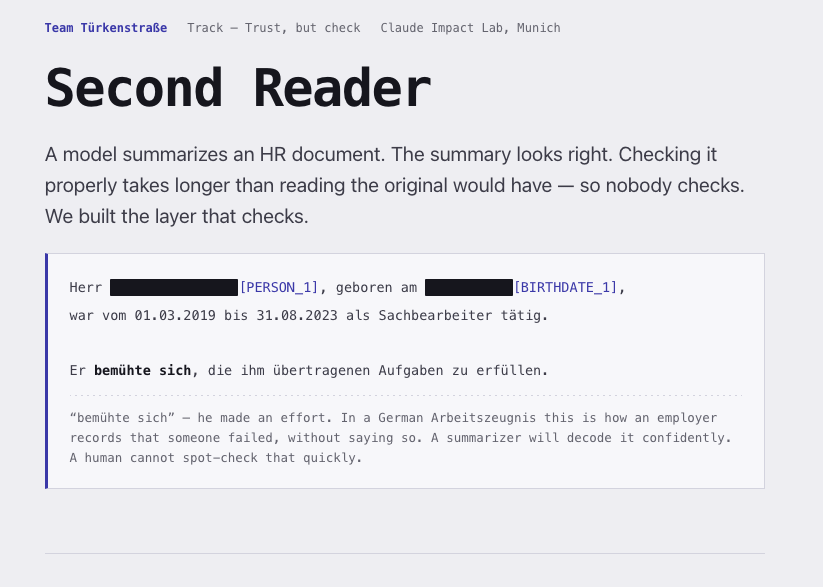
Check26’s Second Reader: Critical Peer Review from AI to AI
“Check26” sends the summary generated by a first model to a second model—which knows nothing about the assignment, only the output and the original source—and has it perform a critical review.
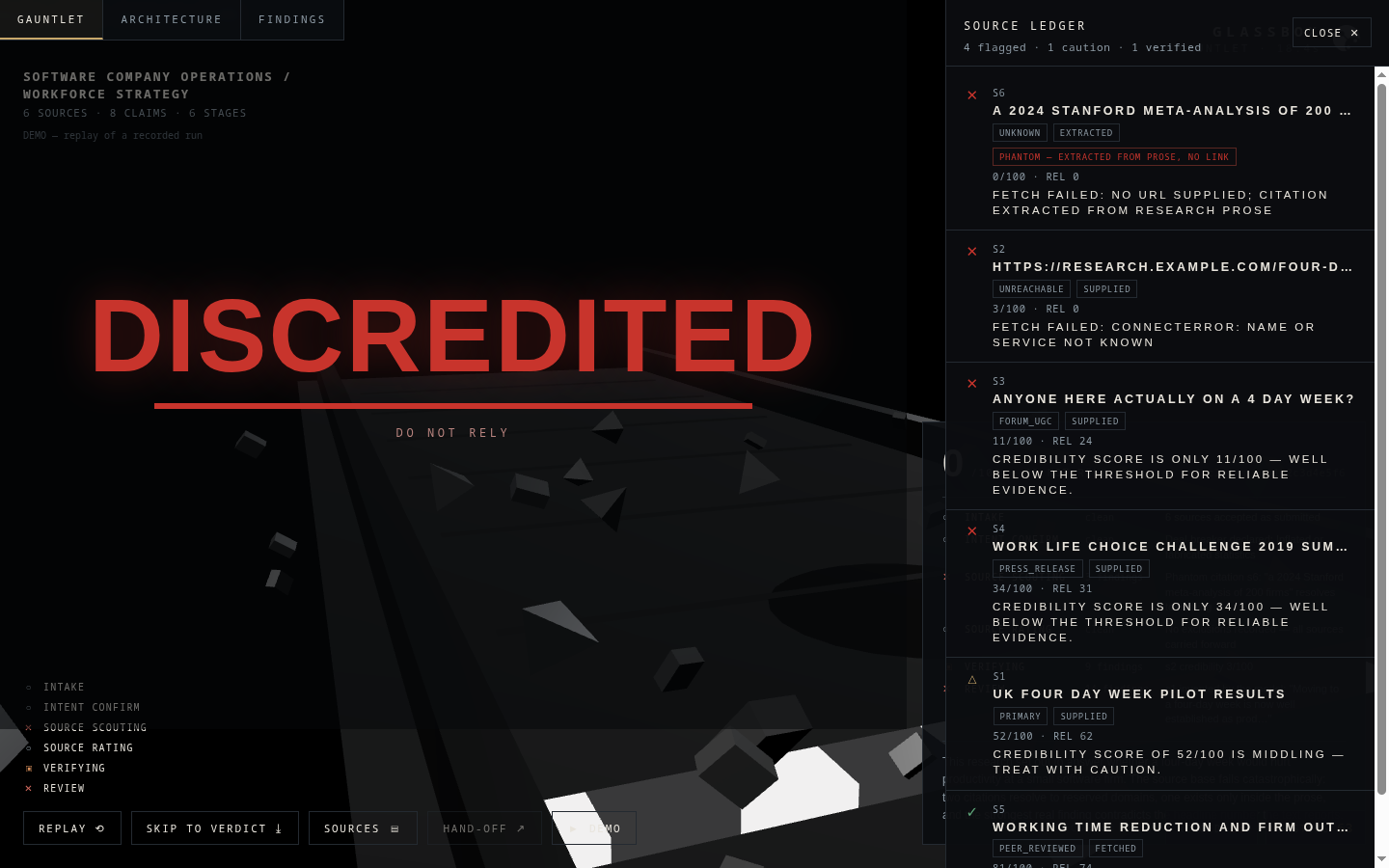
A blunt statement: Glassbox leaves no room for doubt
“Glassbox” also scrutinizes an AI-generated research paper and its underlying sources and tells you to what extent you can actually trust it—but it lays bare every step of the research process and ultimately rates each claim as substantiated, partially substantiated, unsubstantiated, or refuted, phrased explicitly “quite bluntly.” For comparison, the team fed the same task once with Gemini results and once with Claude results—introducing it with an audible smirk: “Who uses Gemini these days?”
“Devil’s Advocate,” Team Trust Nobody, built an RSS pipeline that sends incoming news from multiple companies through a chain of verification agents and classifies it as confirmed or unconfirmed, with the goal of relieving editorial teams of manual verification work. The impetus came from a team member who works as a journalist himself.
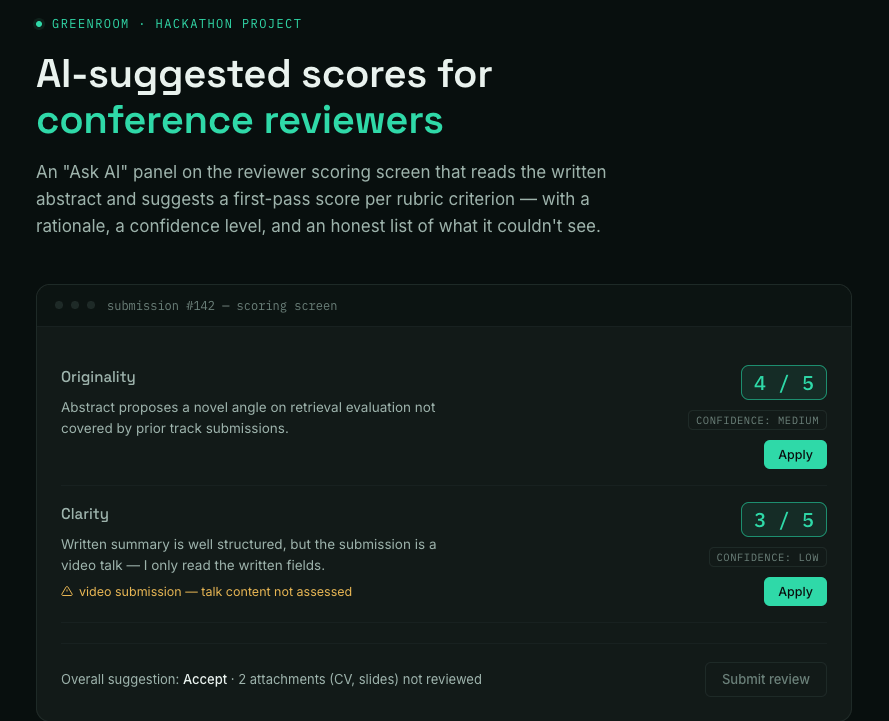
Green Room: How relevant are conferences to you?
“GreenRoom,” Team 47AI, evaluates conference presentation proposals based on relevance, originality, and speaking skills and suggests a rating—as a more affordable, AI-powered alternative to existing program committee tools that, according to the team, are expensive and lack AI support.
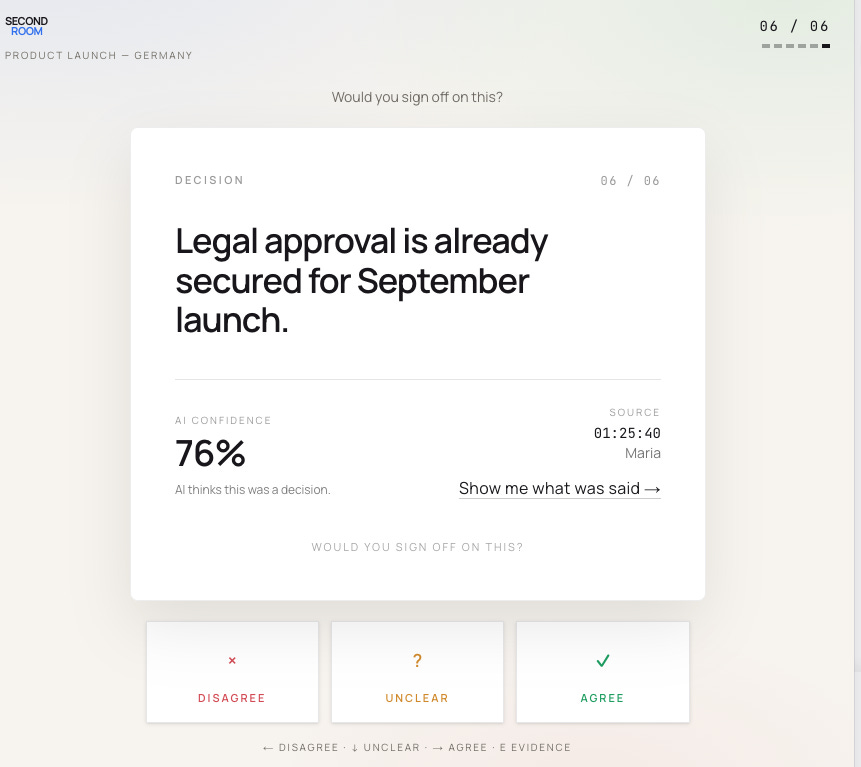
After the meeting: get on the same page, even if you weren’t there. Every meeting should have a “Second Room”
And “Second Room” (Team 2nd Room) doesn’t simply accept AI-generated meeting summaries; instead, it presents every single statement in a Tinder-style format for confirmation, disagreement, or “open,” including a supporting quote and a comparison of AI and human confidence levels. Their motto: “the meeting doesn’t end when the meeting ends.”
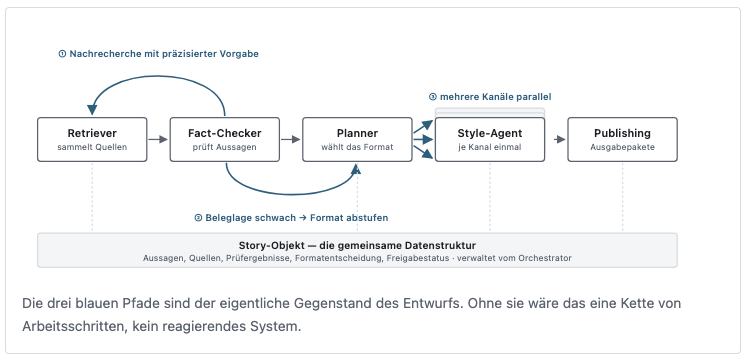
The “Journalist Assistant” is designed to support research work throughout the entire journalistic workflow
The Promptologist helped build it himself that afternoon. The one-person team “Journalist Assistant” built a six-agent system following the classic workflow: research, fact-checking, planning by channel, style, and publication, with feedback loops between the stages. The inspiration came from his own professional experience at a healthcare publisher, where facts are non-negotiable. By the time of the pitch, only one component was actually in place: the fact-checker—along with the still-unresolved question of which thresholds in his own field should be considered “confirmed,” “controversial,” or “false.”
“Wasn’t Me” built an editorial filter that identifies sensitive information in a document and pseudonymizes it before the text even reaches a language model—with confirmation from the user as to which categories should be redacted.
Seven teams were in the Trust Track, plus an eighth project outside the track that ultimately addressed the same problem—it was clear that day that concerns about trust weren’t limited to just one track.
The Rest of the Show
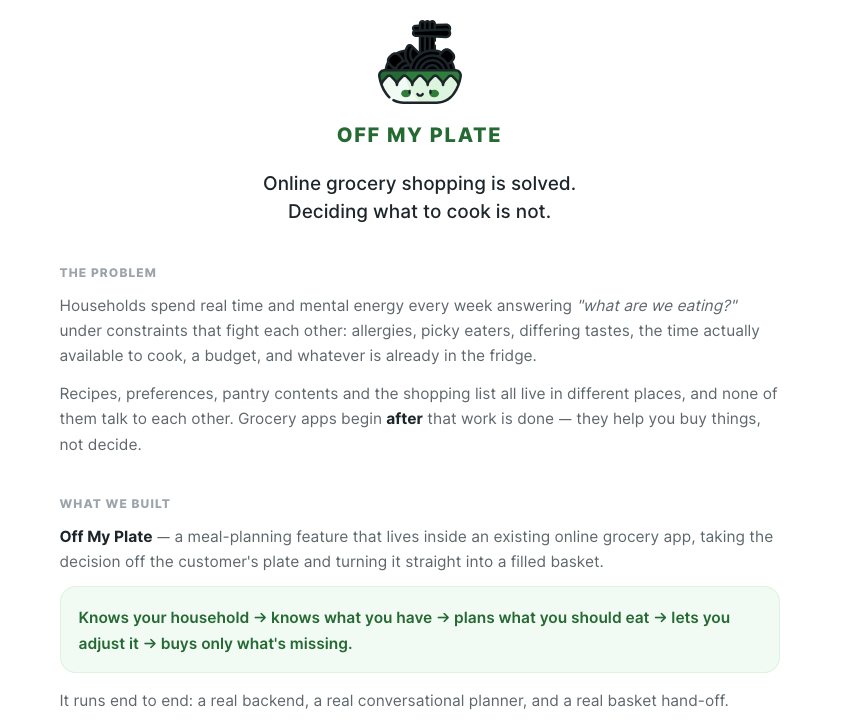
What’s on the menu today: “Off My Plate” plans and prepares the order directly
The remaining eight projects covered a broader range of topics. “Off My Plate” tracks a household’s allergies, preferences, and pantry stock, plans meals that everyone will actually enjoy, and converts the plan into a shopping cart containing only the missing ingredients. The shopping cart with the delivery service is thus automatically filled—demonstrated by a mother of two who ordered a vegetarian dinner for four people, with Claude Opus as the orchestrator and Sonnet and Haiku as subagents in the background. Almost fully developed—real backend, dialog-oriented planner, and handoff to the shopping cart, all covered by browser tests.
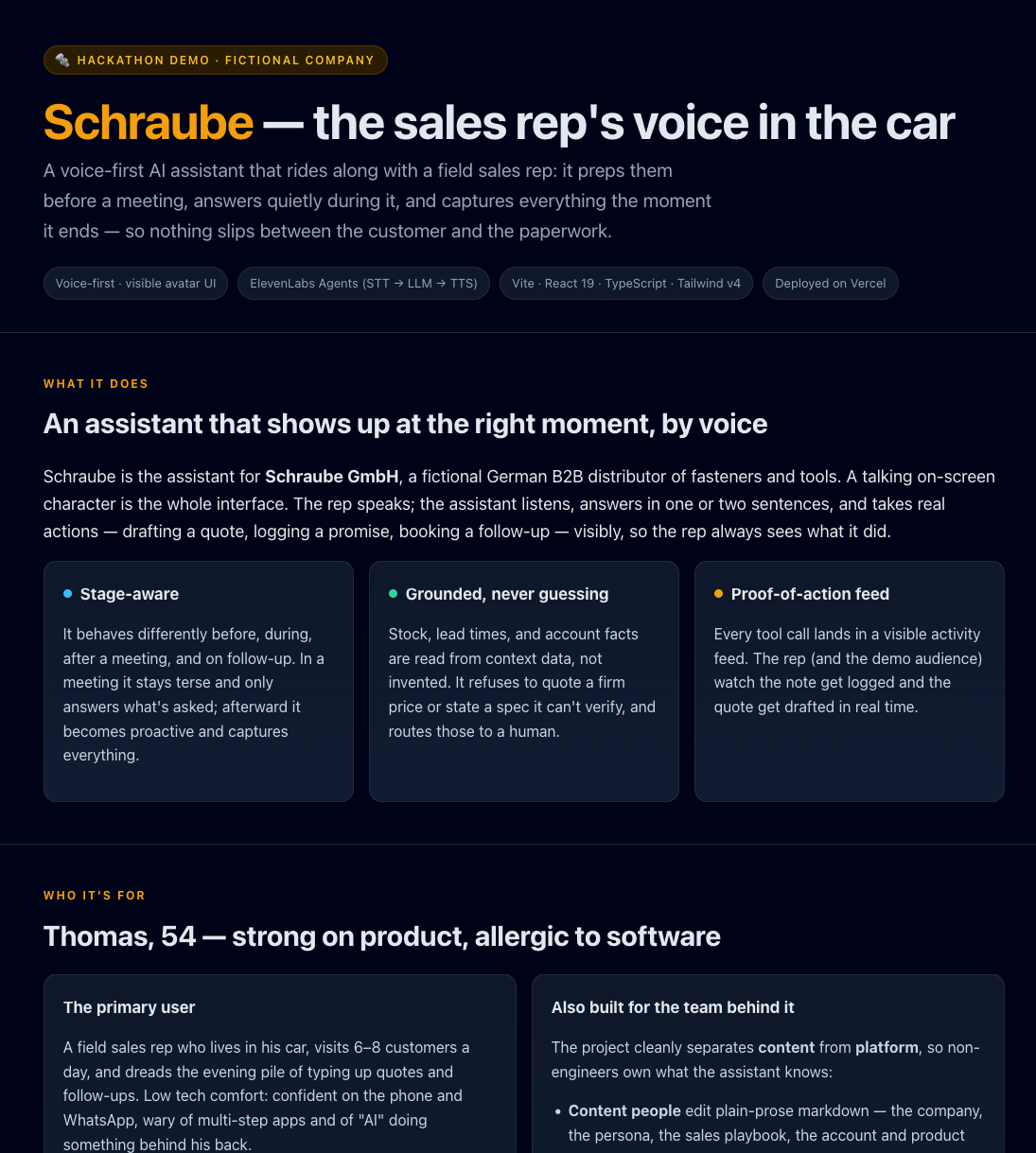
Voice Assistant for Sales Reps: “Schraubi” Provides All Relevant Information for Customer Appointments While on the Go
“Schraubi” (team motto: “Save the Mittelstand”) is a voice-controlled car assistant for sales reps at German SMEs—a pure voice assistant with no screen interface, since the target audience is often on the road in their cars. Deliberately programmed to be “fact-based, without ego-boosting,” it demonstrates its capabilities through a query before a client meeting: open contract deadlines, a competing offer, and a pending commitment that hasn’t yet been confirmed. The figures cited in the pitch regarding small and medium-sized enterprises—60 percent of the German economy, 70 percent of salespeople between the ages of 40 and 65—highlight the potential for such a solution.
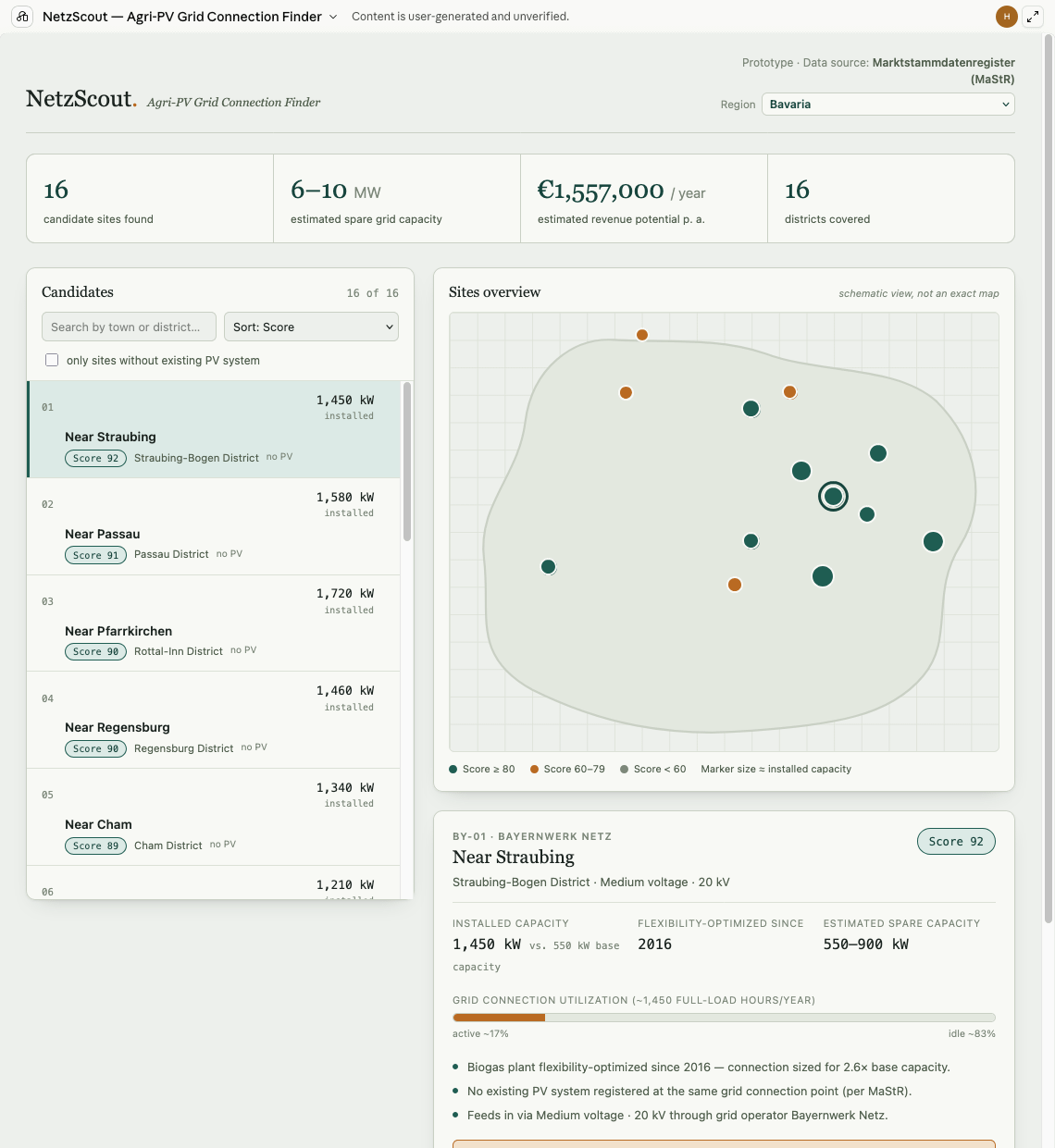
Quick Grid Connection: Searching Thousands of Biogas Plants in Bavaria with Unused Grid Capacity for Agri-Photovoltaic Connections
“AgriRadar” searched through thousands of biogas plant registries in Bavaria for unused grid capacity to help agri-photovoltaic projects secure a grid connection faster than through the regular application process—which often takes years—and, according to the team, was built in half a day, including an analysis of approximately 1.4 million data rows.
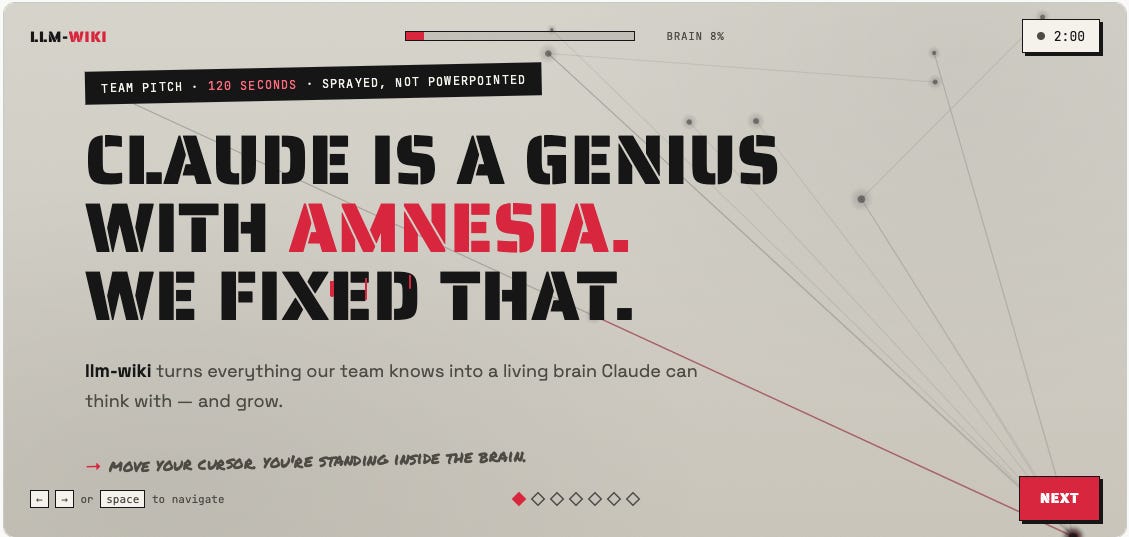
A Memory for Claude: Fixing LLMs’ Amnesia
“LLM-Wiki,” by Team Brain Extension, took up Andrej Karpathy’s idea of the LLM-Wiki: Instead of starting from scratch with every new chat, Claude is continuously fed documents, which it stores in a growing wiki, retrieves, and—after consultation—updates itself. Illustration from the team: the language model as a processor, the context window as working memory, and the wiki as long-term memory. The project’s motto: Claude is a genius with amnesia, and they wanted to fix that.
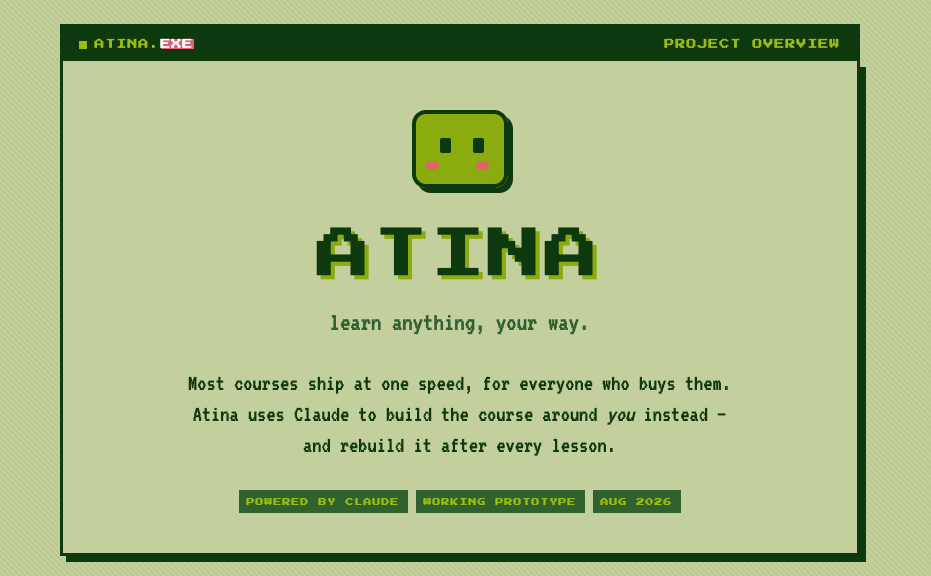
Personalized learning platform with dynamically generated content: Atina
“Atina” built a personalized learning platform: Instead of offering all users the same linear course, it tailors the learning path to each learner’s interests, knowledge level, and learning style. For the MVP, the team tested this approach using history as an example: A learner can start with a broad topic like World War II or art history and explore it through interconnected events, people, ideas, and questions. In principle, this works with any topic, including AI-powered queries, concept maps, and progress analytics.
“Dream Catcher” (Team Carrots) translates a vaguely expressed life dream—in the example, a trip to Antarctica—into estimated costs and concrete next steps.
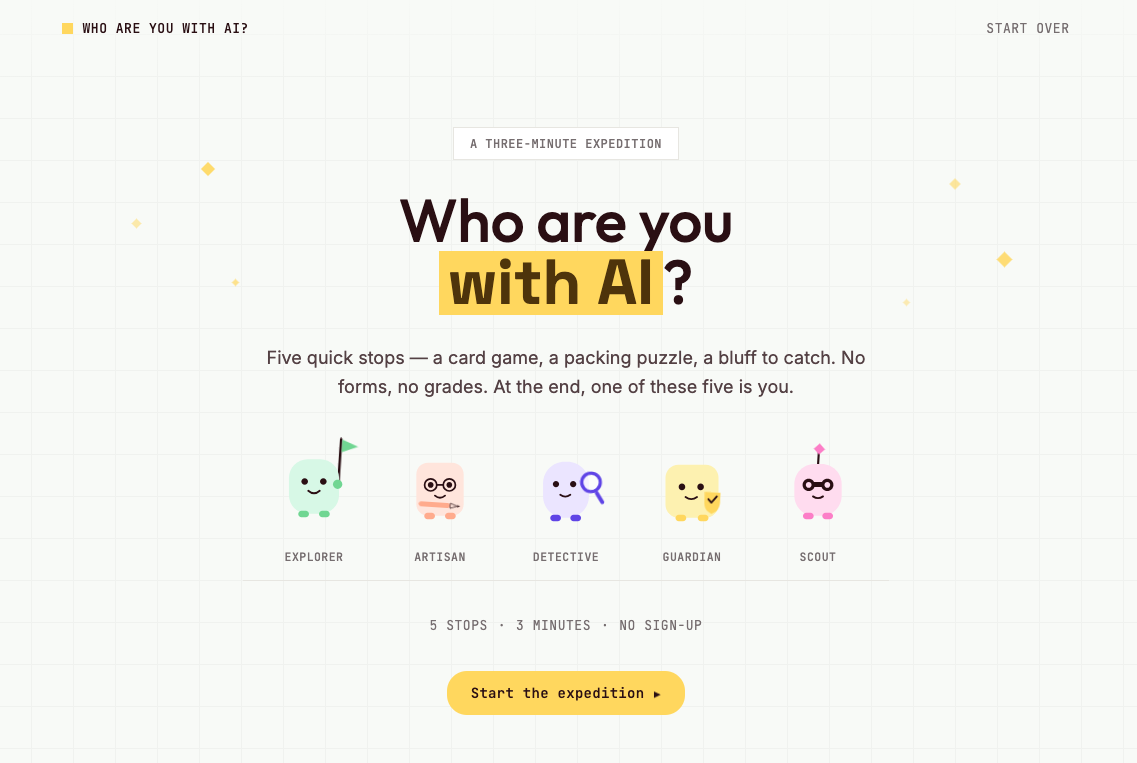
Team Dora: Find the Right AI Work Style for You
“Who Are You with AI?” (Team Dora) is a three-minute, playful self-assessment that derives a personal AI work style from your own role description and suggests tailored job experiments.
No Ranking, Just a Few Prizes
Unlike at many hackathons, there was no single winner. The focus of the day wasn’t on the fastest or most technically advanced solution, but rather on enabling as many people as possible—with and without a technical background—to achieve something—hence several smaller prizes for different categories instead of a grand prize. The small-business assistant Schraubi received a lot of recognition, as well as a prize for the most playful project of the day.
The host, make, has since posted a video recap online—edited using the AI video tool Fable—along with photos from the day. For Munich, this was the second event of its kind held at the same venue, with the announcement that it won’t stop there: The community will meet monthly going forward, organized by Michael Whelehan, Alexander Eiswirth, and Munich’s Claude ambassador Florian Steiner.
→ Video from the day → Photos → More Photos
Der Promptologe, August 17, 2026
Disclosure: This post was created with the help of Anthropic Claude.